Silica dust remains one of the most serious occupational health hazards across Australian construction sites. Breathing in fine particles of respirable crystalline silica (RCS) from everyday tasks such as cutting, grinding, or drilling concrete, masonry, and engineered stone can cause silicosis, a permanent and potentially fatal lung disease. Since 1 September 2024, stronger obligations under the Model WHS Regulations have placed greater accountability on principal contractors, PCBUs, and subcontractors alike.
What is a Silica Risk Control Plan (SRCP)?
An authentic, silica risk control plan template Australia-compliant SRCP is a formal, written document a PCBU prepares to identify crystalline silica substances on site, assess worker exposure risks, and document the specific control measures — engineering, administrative, and respiratory protective equipment (RPE) to keep workplace exposure to standard silica Australia limits of 0.05 mg/m³ (8-hour TWA) or below. A single generic plan is not legally sufficient: each site and project lifecycle requires its own site-specific assessment and documented controls.
A well-designed SRCP protects workers, satisfies regulator expectations, and supports site-wide safety management. This guide explains current obligations, walks through each step of preparing a compliant plan, and shows how professional site security, from construction site security guards to wireless solar CCTV towers, can help protect the people, equipment, and monitoring systems that underpin a healthy work environment.
Understanding the Safe Work Australia Silica Code of Practice & WES Standards
1.1 Shift to the Current Workplace Exposure Standard Silica Australia (WES)
Safe Work Australia currently sets the workplace exposure standard for respirable crystalline silica (RCS) at 0.05 mg/m³ as an 8-hour time-weighted average (TWA). This significantly tightens employer obligations across the industry.
The strengthened Model WHS Regulations changes took effect on 1 September 2024. Safe Work Australia develops model codes and guidance, including the Safe Work Australia silica code of practice (Model Code of Practice: Managing Risks of Respirable Crystalline Silica), but does not enforce WHS laws directly. Each state and territory regulator is responsible for enforcement: SafeWork NSW, WorkSafe Victoria, Workplace Health and Safety Queensland, and WorkSafe WA, among others.
New South Wales, Western Australia, Tasmania, South Australia, Queensland, and the Northern Territory have adopted the changes to the Model WHS Regulation. Victoria had crystalline silica regulations in place from 2021, administered by WorkSafe Victoria. PCBUs operating across multiple jurisdictions should confirm requirements with each applicable regulator, as obligations may differ in their detail.
1.2 High-Risk Crystalline Silica Processing Defined
Under regulation 529A(2), a crystalline silica substance (CSS) is any material containing at least 1% crystalline silica. This captures a wide range of everyday construction materials, including concrete, masonry blocks, bricks, clay roof tiles, sandstone, and engineered stone benchtops.
The Model WHS Regulations define “processing” under regulation 529A(1) as using power tools or mechanical plant to crush, cut, grind, trim, sand, abrasively polish, or drill a CSS. Common site activities that fall within this definition include angle-grinding concrete, chasing masonry walls for services, diamond-blade cutting tiles, core drilling floors, and dry sweeping silica-heavy debris.
Under regulation 529CA(2), a PCBU must conduct a comprehensive site risk assessment for silica to determine whether any processing activity is “high risk”. Not every short-duration task automatically triggers identical obligations; the risk assessment outcome determines what controls and documentation are required. Where processing is assessed as high risk, a written silica risk control plan template (Australia-compliant plan must be prepared before work begins.
1.3 The Intersection of WHS Compliance and Site Access Security
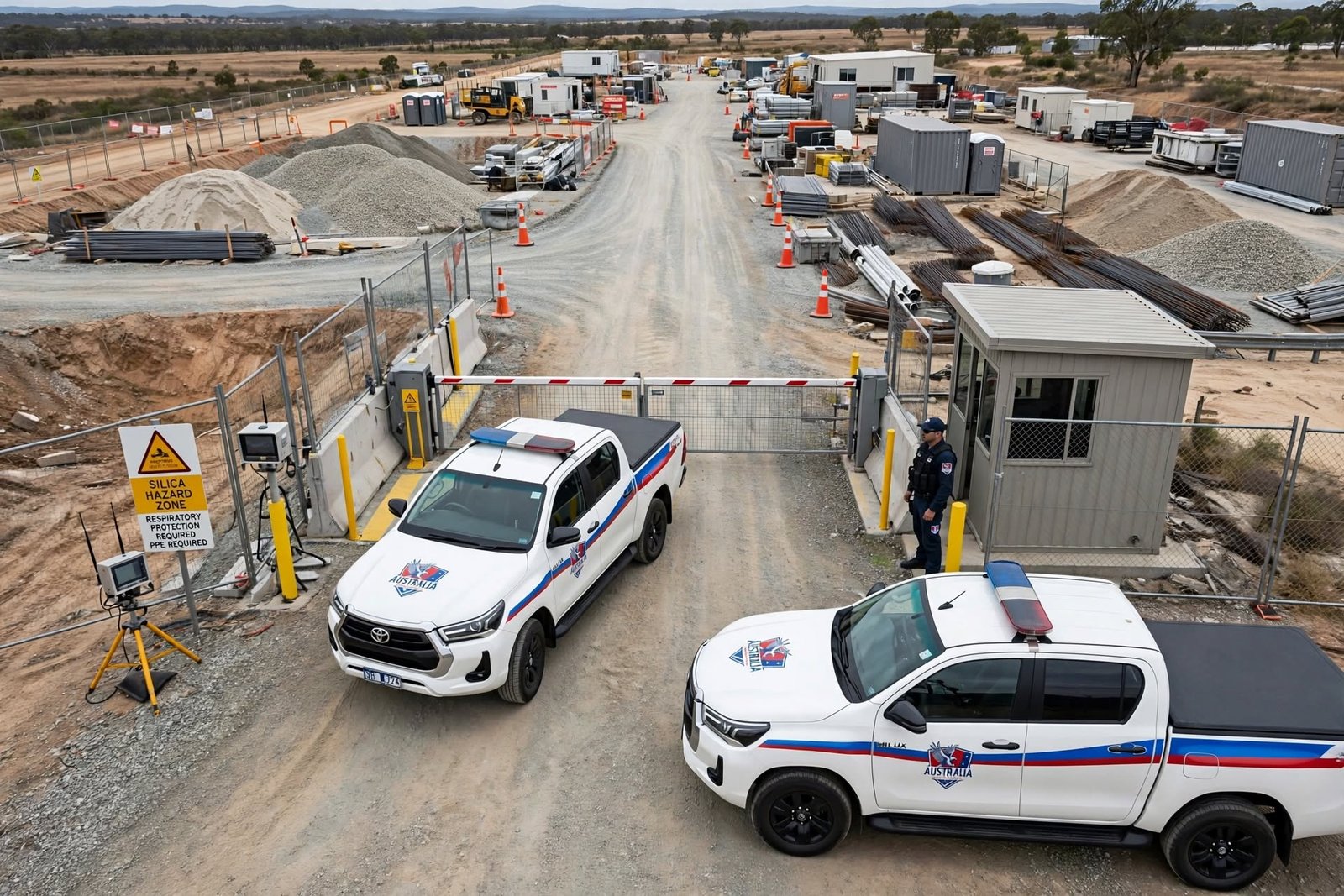
Site access arrangements, physical perimeter controls, and security personnel can actively support a site’s WHS management system, particularly in maintaining designated hazard-area boundaries and preventing unauthorized entry during silica-generating activities.
It is essential to be clear about roles: licensed security guards’ site compliance functions mean that security personnel can enforce agreed access procedures, verify induction completion, maintain entry registers, and escalate concerns to site supervisors. They support and do not replace the PCBU’s and contractor’s statutory WHS obligations. Legal responsibility for preparing and implementing the SRCP, conducting air monitoring, and providing health monitoring rests firmly with the PCBU.
Physical & Security Risks on High-Risk Construction Sites
2.1 Theft of High-Value Silica Abatement & Dust Extraction Equipment
Effective silica dust control depends on specialized equipment operating correctly and continuously. M-Class and H-Class HEPA vacuum systems, on-tool water suppression attachments, local exhaust ventilation ducting, and slurry management units represent substantial capital investment. When this equipment disappears from a site, whether through opportunistic theft, contractor vehicle break-ins, or unsecured storage, the consequences reach beyond the financial.
A PCBU whose required engineering controls are unavailable must reassess work methods before processing activities resume. Continuing work without the required controls in place may itself constitute a breach of the risk management obligations under the Model WHS Regulations. Asset protection measures, controlled storage areas, equipment registers, perimeter lighting, and monitored access to plant storage zones help maintain the continuity of dust control systems that workers depend on.
Utilizing construction site security equipment Australia solutions, such as mobile patrol services and asset-tagged storage enclosures, can form part of a broader equipment protection strategy, though they complement and do not substitute for formal WHS controls.
2.2 Perimeter Control and Unauthorized Site Encroachment
Active silica-generating work areas present real hazards to anyone who enters without appropriate induction, respiratory protective equipment (RPE), or awareness of exclusion-zone boundaries. Unauthorized access by members of the public, delivery personnel, neighboring tradespeople, or after-hours intruders creates both a health risk and a severe site liability.
Physical controls, including solid perimeter fencing, locked access gates, hazard warning signage, and clearly marked exclusion zones, form the first line of defense. Procedural controls, visitor registration, mandatory contractor inductions, and defined escalation procedures for unauthorized-access incidents reinforce the physical barriers.
Licensed security guards for site compliance personnel can staff entry points, verify induction records, and direct visitors to the appropriate supervisor when technical WHS questions arise. Responsibility for determining who may enter a high-risk processing zone rests exclusively with the PCBU and site supervisor.
2.3 Vandalism of Environmental Air Monitoring Systems
Air monitoring equipment, whether personal exposure monitors worn by workers or static environmental samplers positioned around a work area, is essential infrastructure when a PCBU has determined that air monitoring is required under regulation 529CE. Monitoring data informs decisions about whether the 0.05 mg/m³ WES is being maintained, and must be reported to the regulator within 14 days if it is exceeded.
Monitoring equipment is vulnerable to accidental damage, deliberate interference, and environmental hazards. Security patrols that include monitoring station checkpoints, CCTV coverage of monitoring locations, tamper-evident measures, and incident logs can support the integrity of data collection without themselves substituting for the technical competence of the occupational hygienist or other qualified person responsible for the monitoring program. A single tamper incident must be documented and assessed by the responsible party.
Step-by-Step Guide: How to Write a Compliant Silica Risk Control Plan (SRCP)
Step 1: Hazard Identification & Material Risk Mapping
Begin by conducting a thorough walkthrough of the project scope and drawings. Identify every crystalline silica substance (CSS) present on site: concrete, masonry, sandstone, tiles, engineered stone, and map the specific tasks, locations, and phases of work where processing will occur. Record which workers or worker groups will be exposed, and estimate likely exposure scenarios based on task duration, tool type, ventilation conditions, and proximity to other trades.
Maintain a living register: construction projects evolve, and new CSS materials or processing activities may be introduced during scope changes or variations. The hazard identification step should be revisited when work scope changes materially.
Step 2: Implementing the Hierarchy of Controls
The Model WHS Regulations and the Safe Work Australia silica code of practice require controls to be applied in accordance with the strict hierarchy: elimination first, then substitution, then engineering controls, then administrative measures, and finally personal protective equipment (PPE) including RPE.
- Elimination: Can the task be designed out? Can pre-cut materials be ordered off-site, or pre-formed elements substituted for on-site masonry cutting?
- Substitution: Use alternative materials with lower crystalline silica content where technically feasible.
- Engineering Controls: Water suppression (wet cutting), on-tool extraction with M-Class or H-Class HEPA vacuums, local exhaust ventilation, or enclosed cabs on plant.
- Administrative Controls: Job rotation to limit exposure duration, work scheduling to minimize concurrent exposure, and isolation of dust-generating work from other trades.
- RPE: Correctly selected, fit-tested, and maintained respiratory protective equipment as a supplementary control, never a substitute for higher-order controls where those are reasonably practicable.
Document the selected controls against each identified task, and justify why each control at a higher level in the hierarchy was not reasonably practicable where it has been omitted.
Step 3: Establishing Exclusion Zones & Security Access Protocols
Define physical exclusion zones around each high-risk processing area. The zone boundary should reflect the realistic airborne spread of dust from the work activity under likely site conditions, not merely the immediate work footprint. Clearly mark zones with physical barriers (bunting, hoarding, or barricade tape) and compliant hazard signage.
Establish documented access protocols: identify which workers are authorized, what credentials (induction, RPE fit-test record, relevant training) must be verified before entry, who holds authority to approve or revoke access, and how entry and exit are recorded.
Our specialized construction site security guards stationed at entry points follow approved site procedures, check required credentials against the access register, and refer technical WHS determinations, including questions about RPE adequacy to the site supervisor or WHS adviser. Security personnel do not independently certify RPE fit testing or determine compliance; qualified WHS personnel perform these functions.
Step 4: Air Monitoring & Baseline Hygiene Records
Where a high-risk determination has been made, and air monitoring is required under regulation 529CE, the monitoring program should be designed and overseen by a competent person, typically a qualified occupational hygienist. Distinguish between personal exposure monitoring (workers wearing sampling equipment) and static environmental monitoring (fixed-position samplers), which serve different purposes and may both be required.
Maintain accurate records of all monitoring results, methodologies, calibration records, and personnel involved. If monitoring results show the WES of 0.05 mg/m³ has been exceeded, report it to the relevant state or territory regulator within 14 days as required by regulation 529CE. Retain all records as required by applicable WHS legislation.
Step 5: Mandatory RPE Fit Testing (AS/NZS 1715)
Respiratory protective equipment is only effective when correctly selected for the hazard, worn properly, fit-tested for each individual wearer, and maintained in serviceable condition. The relevant Australian standard for the selection, use, and maintenance of RPE is AS/NZS 1715.
Fit testing establishes that a particular RPE model creates an adequate seal on an individual’s face. Workers required to wear tight-fitting respirators (half-face or full-face) must be fit-tested. PCBUs must train workers on crystalline silica risks under regulation 529CD, including proper RPE donning, seal-checking, and maintenance. Maintain fit-test records and RPE maintenance logs as part of your SRCP documentation package.
Step 6: Incident Management, Security Audits & Site Record Retention
An effective SRCP includes a clearly documented incident management procedure: how suspected overexposure events are escalated, how equipment loss or failure is reported and remediated, how unauthorized-access incidents are documented and reviewed, and how corrective actions are assigned and closed out.
Security logs, including records of perimeter checks, entry and exit events, equipment audits, CCTV incident flags, and monitoring station inspections, complement the WHS management system but are not formal WHS records. Formal WHS incident and monitoring records must be maintained in accordance with the applicable legislation. Schedule periodic reviews of the SRCP at a minimum following any WES exceedance, significant incident, scope change, or change in personnel.
The Role of Professional Security Services in WHS & Dust Compliance
4.1 Security Guard Inspections & Site Access Enforcement
Trained and licensed security personnel can provide valuable support to a site’s WHS management system. Their scope of work is defined by their training, licensing requirements under applicable state or territory security industry legislation, the site’s access procedures, and instructions from the principal contractor or PCBU.
In practice, this includes staffing entry and exit points during high-risk processing activities, verifying that all persons entering controlled areas have completed the required site induction, maintaining a contemporaneous entry register, conducting perimeter patrols to identify unauthorized encroachments, and escalating incidents to the nominated site supervisor. Construction site security guards from Australia Security Forces are experienced in construction site environments and work to site-specific access protocols.
4.2 CCTV Monitoring & AI Analytics for Exclusion Zone Breaches
Fixed and mobile CCTV systems provide continuous visual coverage of perimeter areas, access gates, and exclusion-zone boundaries during and after working hours. Modern CCTV analytics can be configured to generate alerts when movement is detected in defined restricted areas, useful for after-hours intrusion detection and for flagging apparent perimeter breaches during active work periods.
There are important limitations to acknowledge. Camera coverage depends on line of sight, positioning, and lighting conditions. Occlusion, dust haze, and connectivity issues can reduce reliability. AI-based analytics can generate false alerts, and all alerts require human verification before any action is taken. CCTV systems cannot reliably verify correct respirator use or confirm fit-test validity in every circumstance. Wireless solar CCTV towers offer rapid deployment at remote construction sites with no hardwired power infrastructure required, providing flexible coverage as site layouts evolve.
Contractor Verification & Compliance Checklist
Use this structured checklist before commencing high-risk silica processing work and at each project review point:
- Current silica-related legal obligations confirmed for the applicable jurisdiction(s).
- Applicable codes and regulator guidance reviewed, including the Safe Work Australia silica code of practice.
- Complete site risk assessment for silica documented, with high-risk or lower-risk determinations finalized.
- Silica risk control plan template Australia-compliant site-specific SRCP prepared for all high-risk processing activities.
- Engineering controls are fully in place and operational (water suppression, LEV, HEPA extraction).
- Air monitoring arrangements established where required, and a competent person engaged.
- Regulator reporting procedure in place for WES exceedances (14-day obligation).
- Worker training on crystalline silica risks completed and records held under regulation 529CD.
- Appropriate RPE selected, fit-tested, and maintained per AS/NZS 1715 protocols.
- Health monitoring arrangements in place for relevant affected workers where required.
- Site access and exclusion-zone procedures documented, communicated, and actively enforced.
- Incident reporting and recordkeeping procedures fully documented and tested.
Frequently Asked Questions
Who is legally responsible for preparing the Silica Risk Control Plan on a principal site?
The primary legal obligation rests with the PCBU, typically the principal contractor for the site under the Model WHS Regulations. PCBUs must conduct or commission a risk assessment and, where processing is determined to be high risk, prepare and implement a site-specific plan. Subcontractors performing high-risk processing work carry concurrent obligations for their own workers. Responsibility cannot be fully delegated to a security provider or any party without the relevant WHS authority and competence.
Can security guards enforce WHS PPE and RPE compliance at site entry gates?
Licensed security guards‘ site compliance roles mean guards can operate within defined, documented access procedures, checking induction completion, verifying approved credentials, and maintaining entry records. They can decline entry to persons who do not meet the documented access requirements and escalate concerns to the responsible supervisor. However, security guards cannot independently assess RPE adequacy, certify fit-test validity, or make formal WHS compliance determinations.
What happens if high-value dust extraction equipment is stolen from a job site?
Loss of required engineering controls (M-Class or H-Class HEPA vacuums, water suppression systems, or LEV equipment) means the PCBU must halt high-risk processing activities until equivalent controls are restored or alternative compliant work methods are assessed and implemented. Continuing processing work without the required controls may breach WHS obligations. Asset protection measures, including surveillance, secure storage, and patrol checks, drastically reduce this operational risk.
Is a Silica Risk Control Plan required for short-duration concrete drilling?
Not automatically. The Model WHS Regulations require a PCBU to first conduct a silica site risk assessment to determine whether the activity constitutes high-risk processing. Short-duration tasks may still generate significant RCS exposure depending on tool type, ventilation, substrate, and accumulated daily exposure time. The risk assessment outcome, not task duration alone, determines whether a formal written SRCP is required. Consult the Safe Work Australia silica code of practice when making this determination.
Integrate Site Security into Your Silica Compliance Strategy
A compliant silica dust management program is built on three foundations: a rigorous site-specific silica risk control plan template Australia-aligned SRCP, effective engineering and administrative controls that keep exposures below the workplace exposure standard for silica in Australia of 0.05 mg/m³, and a site environment where hazard zones, monitoring infrastructure, and essential equipment are protected.
Professional security services, including construction site security guards and wireless solar CCTV towers, form a meaningful part of that protection architecture. They help maintain exclusion-zone integrity, protect irreplaceable dust-control equipment, and support the access-management procedures your SRCP requires.
Australia Security Forces provides specialist construction site security and mobile CCTV solutions for high-risk work sites across NSW, Victoria, Queensland, and Western Australia. Contact our senior management directly to configure your site access protocols.
- NSW SLED Master License: 000 107 741
- ABN Registration: 84 638 907 105
- Corporate Liability Indemnity: $20 Million Comprehensive Public Liability Policy
📞 Call Now for an Express Commercial Quote: 1300 450 415
✉️ Email Our Technical Estimating Team: Support@australiasecurityforces.com.au