Most articles on construction site security tell you the same thing: sites are vulnerable, theft happens, hire a guard. What they don’t tell you is what actually gets stolen and when, what it really costs once insurance and delays are factored in, what your insurer expects you to have in place, or how to decide between a guard, a patrol, and a camera system for your specific project.
This guide covers all of that, not just a list of services, but a framework for building a construction site security plan and identifying the right construction site security measures for your site, your budget, and your project stage.
What Actually Gets Targeted on Australian Construction Sites
Not all theft is opportunistic. A meaningful share of construction site theft is carried out by people who’ve scouted the site beforehand, noting delivery schedules, checking when the site is unattended, and returning once they know the pattern.
The items most commonly targeted:
- Copper wiring and cabling – high resale value, hard to trace once removed
- Power tools and small plant – easy to carry, quick to sell
- Generators and fuel – portable, in constant demand
- Fixtures and appliances – targeted heavily near project completion
- Structural materials – timber, steel, and fittings left unsecured overnight
Timing matters too. Incidents cluster around weekends, public holidays, and the first couple of weeks after a site is mobilized, before security routines and site discipline are properly established. Early-stage, partially fenced sites are also disproportionately targeted simply because access is easiest.
What Site Theft and Vandalism Actually Cost You
The direct cost of a stolen generator or a pallet of copper is usually the smallest part of the bill. The real cost shows up elsewhere:
- Replacement and re-procurement, often at short notice, at a premium
- Project delays, contractors idle, schedule penalties, flow-on costs to other trades
- Insurance excess, payable regardless of claim size
- Premium increases, a claim history can push up contract works insurance costs on future projects
- Rework, vandalism to partially completed structures isn’t just cosmetic; it can mean redoing compliance-checked work
A single break-in that costs a few thousand dollars in stolen tools can easily cost tens of thousands once delay and insurance impacts are included, which is why on most active sites, professional security pays for itself well before the second incident, not after several.
Guards vs Mobile Patrols vs CCTV/AI vs Fencing: An Honest Comparison
There’s no single “best” option, the right choice depends on your site’s value, risk profile, and stage. Here’s how the main construction site security services actually compare.
| Option | Best for | Strengths | Limitations |
|---|---|---|---|
| Static security guards | High-value sites, urban locations, sites with a theft history | Visible deterrent, immediate on-site response, can manage access/deliveries | Highest ongoing cost |
| Mobile patrols | Mid-size sites, lower risk profile, budget-conscious projects | Lower cost than static guarding, still provides scheduled deterrence and checks | Gaps between visits; not a real-time response |
| CCTV / AI monitoring | Remote or regional sites, projects needing documentation (timelapse, compliance, client updates) | 24/7 coverage, predictable monthly cost, doubles as project documentation | Response depends on control room and alarm verification, not physical presence |
| Fencing, hoarding & signage | Every site, regardless of what else is used | Baseline legal/insurance requirement, cheap deterrent | Not a standalone security solution on its own |
| Hybrid (most professionally run sites) | Active builds with meaningful asset value | Combines deterrence, coverage, and response | Higher setup coordination |
In practice, most well-run sites don’t pick just one. Perimeter security for construction sites, fencing and signage, is the baseline everyone needs regardless of what else is in place; guards or patrols are layered on for active-build phases; construction site security cameras and AI-monitored systems are increasingly used either as the primary layer on remote sites or as a documentation and verification layer alongside guards.
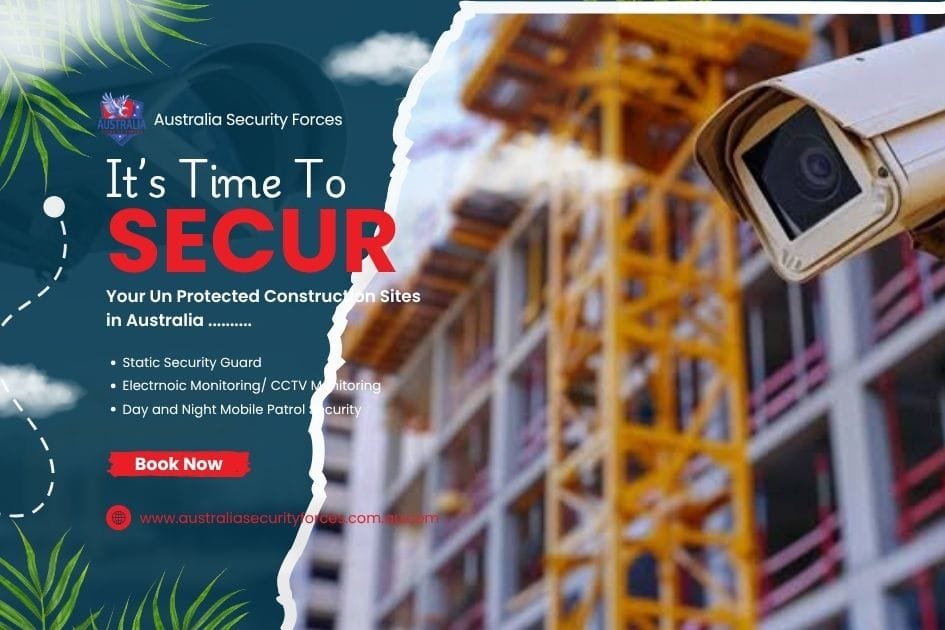
For sites with limited mains power, solar-powered security cameras for construction sites are a common workaround, they connect over 4G, deploy quickly, and don’t rely on a fixed power source. And for shorter projects, construction site security camera rental is often more cost-effective than a permanent CCTV install, since equipment can be redeployed to the next site once the build wraps up.
What Construction Site Security Actually Costs in Australia
Pricing for construction site security services varies by provider and region, but as a rough guide, and this applies whether you need cover for a multi-year build or just temporary construction site security for a short-term project:
- Static guards: typically charged hourly, with rates varying by whether the role is unarmed, licensed-only, or includes access control duties. Overnight and weekend rates run higher than standard business hours.
- Mobile patrols: charged per visit or as a scheduled package (e.g. nightly drive-by checks), generally the lowest-cost option for regular coverage.
- CCTV/AI monitoring: usually a flat monthly rental covering equipment, connectivity, and control room monitoring, the most predictable cost structure of the three.
What actually moves the price:
- Site size and number of access points, more perimeter to cover, more cost
- Metro vs regional location, regional and remote sites often carry a premium for guard travel or patrol frequency
- Coverage hours, after-hours only vs full 24/7
- Project duration, longer engagements can often be negotiated down
- Risk profile, a site with a prior incident or in a known theft hotspot will typically cost more to insure and secure
If a provider won’t give you even a rough range without a full site visit, that’s not unusual, but you should still be able to get a ballpark figure over the phone based on site size and coverage hours before committing to an assessment.
Insurance and Legal Obligations You Can’t Ignore
This is the part almost nobody covers, and it matters more than most builders realise.
Insurance. Contract works insurance and public liability policies often carry conditions tied to site security, minimum construction site security fencing standards, lockup requirements after hours, and in some cases a requirement for monitored alarms on higher-value sites. If those conditions aren’t met and an incident occurs, insurers can reduce or deny a claim. It’s worth checking your policy wording directly, or asking your broker specifically what security measures are required to keep cover valid, don’t assume a standard hoarding fence is enough.
Legal obligations. Under work health and safety law, a builder’s duty to secure a site doesn’t stop when work stops for the day, on weekends, or between trades. An unsecured site is a liability risk to the public, particularly children, who are considered at heightened risk of injury if they gain access to an active or partially built site (sometimes referred to as an “attractive nuisance” risk in liability terms). Requirements around fencing height, hoarding, and signage vary by state and often by local council, so it’s worth confirming the specific requirements for your project’s location rather than relying on a generic standard.
The practical takeaway: security isn’t just about preventing loss, it’s often a condition of your insurance being valid at all, and a legal obligation regardless of whether the site is actively worked.
Matching Security to Your Project Stage
Security needs aren’t static, they should shift as the project does.
Early groundworks. On-site value is low, but liability exposure is high (open excavations, unfenced hazards). Priority here is fencing, hoarding, and clear signage, the legal minimum, and often enough on its own at this stage.
Active build (framing through fit-out). This is the highest-risk window. Tools, plant, copper, and materials are on site in volume, and crews rotate daily, making it easy for an unfamiliar face to go unnoticed. This is typically where a static security officer, patrols, or CCTV monitoring earn their cost.
Near completion. Appliances, fixtures, and finishes are now on site, high-value, easily resold, and often installed before a site is fully secured for handover. Security should stay in place right through to practical completion, not taper off once the structure is up.
Quick construction site security checklist
- Perimeter fencing and hoarding installed before any materials arrive
- Clear, compliant signage at all entry points
- Delivery and subcontractor sign-in process in place
- Lighting covering all access points and storage areas
- Valuable materials stored away from street-facing boundaries
- Forensic tool marking applied to portable plant and equipment
- Security coverage level reviewed as the project moves between stages
- Insurance policy checked against current on-site security measures
A few low-cost measures are worth doing at every stage regardless of what else you hire: keep valuable materials stored away from the street-facing perimeter, ensure adequate lighting at night, use forensic tool marking (such as DataDotDNA) to deter resale of stolen equipment, and enforce strict delivery and subcontractor sign-in discipline. None of these replace guards or CCTV, but they measurably reduce opportunistic theft and cost very little.
How to Choose a Construction Site Security Company
Not all construction site security companies are equal, and the cheapest quote isn’t always the best value once you factor in response times and reporting quality. Before you hire private security for a construction site, it’s worth asking:
- Are guards licensed in your state, and are they background-checked?
- Do they have specific construction site experience (site inductions, WHS awareness), not just general guarding?
- What does incident reporting actually look like, digital logs, photo/video evidence, real-time alerts?
- What’s the actual response time if an alarm is triggered after hours?
- Can they scale coverage up or down as your project moves through stages?
Be cautious of providers who can’t explain their response process clearly, or who quote a flat rate without asking anything about your site, construction security isn’t one-size-fits-all, and a provider who treats it that way probably isn’t tailoring the plan to your actual risk.
Frequently Asked Questions
How much does construction site security cost in Australia? It depends on the method, site size, location, and hours of coverage, mobile patrols are generally the lowest cost, static guarding the highest, with CCTV/AI monitoring sitting in between as a predictable monthly cost. Most providers can give a rough range before a full site assessment.
Is construction site security legally required? There’s no single blanket law mandating a guard or camera system, but WHS obligations require builders to secure a site against public access and hazards at all times, including when unattended, and state/council fencing and signage requirements apply regardless of project stage.
Does construction site security affect my insurance? Often, yes. Many contract works and public liability policies specify minimum security measures (fencing, lockup, monitored alarms), and failing to meet them can affect a claim if an incident occurs. Check your policy wording or ask your broker directly.
What’s better for a construction site, a security guard or CCTV? Neither is universally better, guards provide immediate physical response and deterrence, while CCTV/AI monitoring offers 24/7 coverage at a more predictable cost, particularly for remote sites. Many active builds use both together.
How quickly can security be deployed to a new site? Most providers can have guards or mobile patrols in place within 24–48 hours of an approved plan, and CCTV systems, particularly solar/4G units, can often be installed within a similar timeframe without needing mains power or internet.
What construction site security measures do I need at minimum? At minimum, every site needs compliant perimeter fencing, hoarding, and signage, this is generally the legal and insurance baseline regardless of project size. Beyond that, the right combination of guards, patrols, or CCTV depends on your site’s value and stage, as covered above.
Do I need a security guard or a CCTV system, or both? It depends on your risk profile. High-value or high-incident sites often justify both, a guard for immediate physical response, and CCTV for continuous coverage and documentation. Lower-risk or remote sites can often be adequately covered by CCTV/AI monitoring alone.
Getting the Right Security for Your Site
Construction site security isn’t a single decision made once at the start of a project, it should flex with your site’s value, risk, and stage. The builders who get the best outcomes aren’t necessarily the ones spending the most; they’re the ones matching the right layer of protection to the right phase of the build.
Searching for construction site security near me? Not sure whether your site needs a guard, a camera system, or both? Get a free construction site security assessment, we’ll recommend construction site security solutions based on your project stage and budget, not a one-size-fits-all package.