
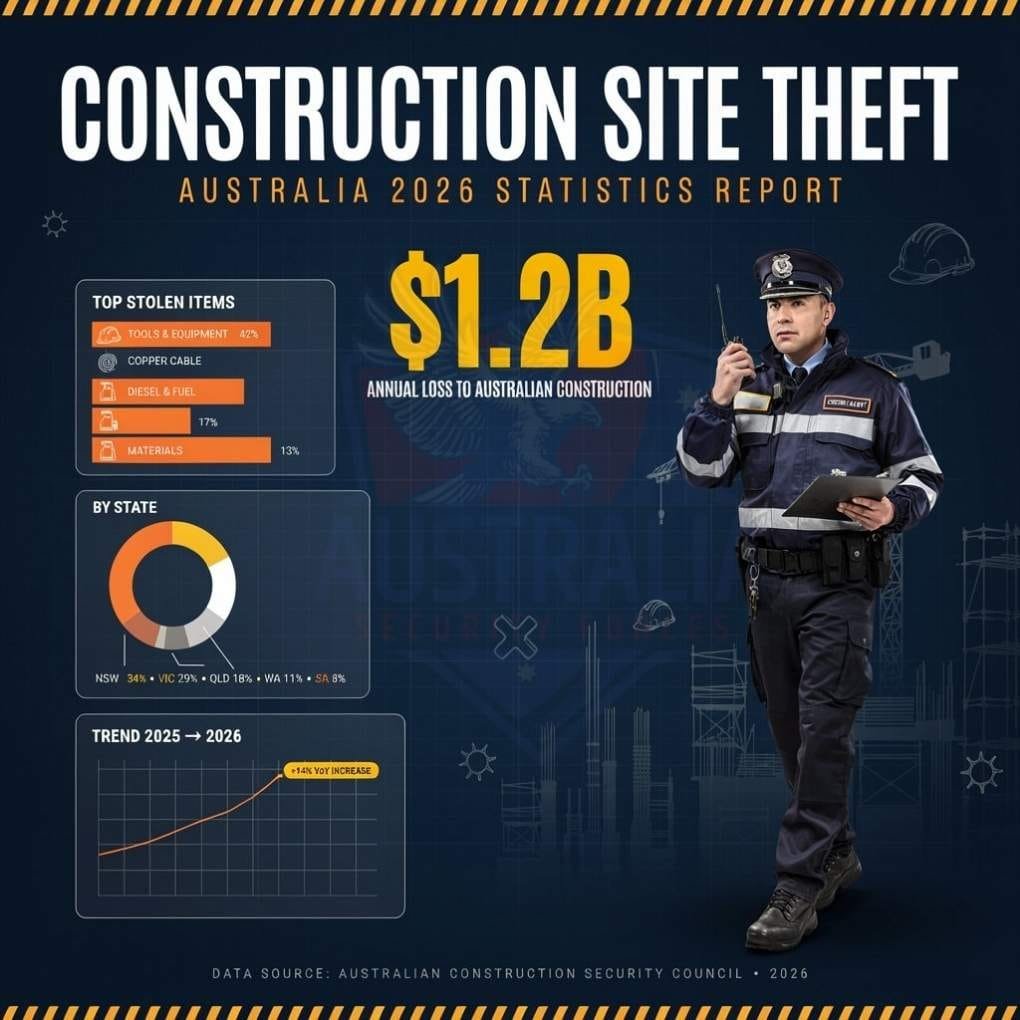
Construction Site Theft Statistics in Australia: What the Data Really Shows
If you manage a residential build or a commercial project anywhere in NSW, you’ve probably heard a headline statistic about how much theft costs the Australian construction industry every year. The problem is that no two sources agree on the number. Some cite figures in the tens of millions, others quote well over a billion dollars often for the same country, the same year, and the same industry.
This article sets out what the data actually supports, where the well-known statistics come from, and what that means practically for a builder or project manager deciding how much to invest in site security.
Why Construction Site Theft Statistics Matter for Builders and Project Managers
Statistics are only useful if they change a decision. For a small residential builder, the relevant question isn’t “what does theft cost the whole industry” it’s “how likely is my site to be targeted, and what does that risk cost me specifically.” For a commercial PM running a multi-stage build, the question is closer to “which project phase carries the highest exposure, and does that justify guards, cameras, or both.”
Reliable statistics help answer three practical questions:
- Is my site more or less exposed than the average, based on location, phase, and value on site?
- What is actually being targeted, so security spend goes to the right place?
- Does the cost of prevention compare favorably to the realistic cost of a theft event, including delay?
How Much Does Construction Site Theft Cost Australia?
Why the headline figures don’t agree
Search “construction site theft statistics Australia” and you’ll find national loss estimates ranging from roughly $40 million to over $1.5 billion a year, sometimes on the same page as a $650 million figure a paragraph later. This isn’t necessarily dishonest, it usually comes down to scope. Some figures cover tool theft only. Others include vandalism, malicious damage, and vehicle theft. Some are extrapolated from insurance claims data (which only captures insured, reported losses), while others are broader industry estimates that include indirect costs like delays and premium increases.
The practical takeaway: treat any single “industry loses $X billion” statistic as a rough order of magnitude, not a precise figure, and look for the underlying source before repeating it in a business case.
The most defensible national estimates
A few figures are consistently traceable to a named, checkable source:
- Tool theft in Victoria cost an estimated $33 million in 2023, a 37% increase on the prior year, according to Crime Statistics Agency Victoria data cited by motoring body RACV.
- Specialist trade insurer Trade Risk’s own claims analysis found that 48% of construction site thefts involve forced entry, with a further 20% occurring through cut padlocks at gates or fencing, and the remainder taken directly from vehicles parked on site.
- The Housing Industry Association confirms that theft from residential building sites runs into the millions of dollars annually across its membership, and links a rise in incidents to periods of increased building activity more active sites simply means more targets.
- Surveys cited by the Master Builders Association have found that a substantial majority of construction businesses report experiencing theft or vandalism within a three-year period, underlining that this is a “when,” not “if,” risk for most builders.
Where this article differs from most others on the topic: it won’t hand you a single national total and imply it’s precise. The honest answer is that Australia doesn’t have one authoritative, government-audited figure for total construction theft losses what we have is a set of overlapping data sources, each measuring a slightly different thing.
NSW Construction Site Theft: What the Official Data Shows
Why NSW doesn’t publish a construction-specific breakdown
This is a gap worth knowing about. The NSW Bureau of Crime Statistics and Research (BOCSAR) publishes detailed, quarterly recorded-crime data by offence type, and its Crime Mapping Tool breaks incidents down by Local Government Area, postcode, suburb, and even premise type. However, “construction site” is not one of BOCSAR’s standard location categories in the way it is in some other states’ datasets the closest equivalents sit inside broader categories like break and enter (non-dwelling) and steal from motor vehicle.
That means a Sydney builder can’t currently pull a single official “construction site theft in NSW” number the way they can for, say, residential burglary. A custom data request to BOCSAR can extract more targeted figures, but this isn’t something available on the public dashboard.
What NSW’s general crime data tells builders
What is publicly available paints a more reassuring picture than the industry hype suggests. NSW Government analysis of BOCSAR data found that reported break and enters in NSW ran around 30% below the national average between 2022 and 2024, and that NSW recorded some of the lowest victimization rates in the country for break and enters, malicious damage, and motor vehicle theft.
This doesn’t mean construction sites are immune they remain a distinct, higher-risk category precisely because they’re temporary, often unoccupied, and full of high-value, portable assets. But it does mean builders should be wary of generic “crime is exploding” framing when the state-level trend is actually flat to improving. The risk on a construction site comes from the nature of the site, not from NSW being an unusually crime-heavy place to build.
Victoria’s Construction-Site Offence Data as a National Benchmark
Victoria is the one state where construction-site-coded offence data is published in enough detail to be genuinely useful, via the Crime Statistics Agency and the Australian Bureau of Statistics. It’s a reasonable proxy for what’s likely happening in comparable NSW growth corridors, even though it isn’t NSW-specific.
The most recent full-year data shows:
- Offences recorded at construction sites and premises under construction reached 4,583 in 2025, up from 4,292 in 2024 and 4,187 in 2023, a steady year-on-year increase as building activity has expanded.
- Within the 2025 total, theft was the largest single category at 2,720 offences, followed by burglary/break-and-enter at 1,397, property damage at 327, public nuisance at 121, and arson at 18.
- The highest-offence local government areas were concentrated in Melbourne’s outer growth corridors precisely the kind of high-activity, rapidly expanding residential and infrastructure zones that NSW’s Western Sydney Aerotropolis and Greater Sydney Growth Centers also represent.
The pattern is consistent with what site security professionals see on the ground: theft risk tracks building activity, and it concentrates in fast-growing, less-established suburbs where fencing, lighting, and site supervision haven’t caught up with the pace of development.
What Gets Stolen Most on Australian Construction Sites
Copper and electrical cabling
Copper remains one of the most consistently targeted materials on Australian sites because of its resale value and portability. Electrical and plumbing rough-in stages after cabling and pipework are installed but before walls close them in represent peak vulnerability. Beyond the material loss, copper theft frequently damages surrounding structure and wiring, triggering costly rework, re-inspection, and safety remediation before work can resume.
Hand tools and small plant
Power tools are the most frequently stolen item category by volume. They’re portable, easy to resell, and often left in vehicles, gang boxes, or unsecured site sheds overnight. Queensland Police data shows tool theft can cost a tradesperson more than the tool’s replacement value, once lost wages and delayed client work are factored in a pattern that applies equally in NSW.
Utes, trailers and heavy machinery
Vehicle and plant theft is less frequent than tool theft but carries a far higher cost per incident. Excavators, bobcats, generators, and site vehicles can be loaded and gone within minutes on an unguarded site. Thieves increasingly use key-programming devices to defeat electronic immobilizers, meaning a locked vehicle is no longer a reliable deterrent on its own.
Materials and fixtures near lock-up stage
As a build approaches lock-up external doors and windows installed the value of materials and fixtures on site rises sharply, and so does theft risk. Timber, fixtures, and fittings delivered ahead of installation are common targets if delivery timing isn’t coordinated closely with the trade schedule.
When Construction Site Theft Happens
The consistent finding across insurer and industry data is that most construction site theft happens outside working hours, with Friday evening through Monday morning representing the highest-risk window the stretch when a site is typically unattended for the longest continuous period. Public holidays and end-of-year shutdown periods carry similarly elevated risk for the same reason: extended, predictable gaps in supervision.
Who Is Behind Construction Site Theft
Theft on Australian construction sites generally falls into three patterns:
- Opportunistic external theft — offenders who identify an unsecured, unattended site and take what’s easily accessible. This accounts for the bulk of after-hours break-ins.
- Organized theft — groups specifically targeting high-value plant, vehicles, or bulk copper for resale through established second-hand or scrap markets. These incidents tend to be planned, fast, and focused on specific asset types.
- Insider-facilitated theft — losses involving workers, subcontractors, or delivery personnel who have legitimate site access. Weak visitor logging, no material sign-out process, and poor contractor ID checks all make this category harder to detect and more likely to recur.
Most site security plans focus heavily on the first two categories and underinvest in controls for the third, even though insider access is one of the easier gaps to close with basic administrative controls.
How Sites Are Actually Broken Into
Trade Risk’s claims analysis, one of the more granular datasets available for the Australian market, found:
| Entry method | Share of thefts |
|---|---|
| Forced entry (cutting, prying, breaking) | 48% |
| Cut padlocks (gates and fencing) | 20% |
| Theft directly from unsecured vehicles | Remainder |
This has a clear practical implication: standard padlocks and lightweight mesh fencing deter almost nobody determined to get in. A site relying only on a padlocked gate is exposed to the two largest entry methods in this dataset simultaneously.
The Real Cost of Theft Beyond Replacement Value
The sticker price of a stolen tool or piece of plant is rarely the full cost. A single theft event typically cascades into:
- Replacement procurement time — specialized equipment can take days to weeks to source, during which the trade dependent on it can’t proceed.
- Labor and scheduling disruption — crews reassigned or idled while replacement gear arrives, creating knock-on coordination problems across trades.
- Liquidated damages exposure — on commercial contracts with penalty clauses for missed milestones, a theft-driven delay can trigger direct financial penalties well beyond the item’s value.
- Insurance friction — claims processing time, excess payments, and, after repeated claims, premium increases or difficulty renewing cover.
- Rework after copper or cable theft — safety inspection and remediation before affected areas can be signed off.
For a project manager, this is the number that should drive the security budget conversation not the replacement cost of the stolen item in isolation, but the realistic delay and downstream cost of the disruption it causes.
Recovery Rates: Why Prevention Beats Recovery
Once a tool or piece of equipment leaves a site, recovery is the exception rather than the rule. Industry estimates consistently put unassisted recovery rates for stolen construction equipment below one in five. Assets fitted with GPS tracking and geofencing tell a very different story industry data suggests recovery rates well above that for tracked high-value plant, because a live location can be handed straight to police rather than relying on a post-incident investigation.
The practical conclusion is simple: prevention and deterrence (fencing, lighting, guards, monitored CCTV, access control) are consistently more cost-effective than betting on recovery after the fact.
The NSW Legal and Regulatory Context
Securing a construction site in NSW isn’t only a loss-prevention decision it’s a legal obligation with real enforcement teeth.
- Work Health and Safety Act 2011 (NSW) sets the core duty to provide and maintain a safe workplace, which extends to keeping unauthorized people out of an active site.
- Work Health and Safety Regulation 2017, specifically section 298, explicitly requires that a workplace be secured against unauthorized access this is the clause most directly relevant to fencing, gates, and after-hours access control.
- SafeWork NSW is the regulator responsible for enforcing these obligations and investigating incidents where inadequate security has contributed to injury on site (including to trespassers, which is a distinct and often overlooked risk).
- Any guard, patrol, or monitoring service engaged must be licensed under the Security Industry Act 1997 (NSW), with licensing administered by the Security Licensing & Enforcement Directorate (SLED) within the NSW Police Force. It’s worth verifying a provider’s SLED license directly before engaging them.
- Security personnel entering an active construction site are generally required to hold a White Card (General Construction Induction), in addition to their security license a detail some builders forget to check.
- Reports of theft, trespass, or break-ins should go to the NSW Police Force, and larger organizations increasingly apply an AS/NZS ISO 31000–aligned risk management approach to formally assess and document site security risk as part of project planning.
High-Risk Construction Zones in NSW
Risk isn’t distributed evenly across the state. Areas with the fastest-growing construction activity tend to carry the highest exposure, largely because site density outpaces the maturity of local security infrastructure and community familiarity with the area:
- Western Sydney Aerotropolis — a large, high-activity infrastructure and development zone where equipment and asset theft is a recognized risk given the scale and pace of works.
- Greater Sydney Growth Centers (including corridors like Marsden Park and Oran Park) fast-expanding residential corridors where new sites open faster than established community and security presence can adapt.
- Hunter Valley and Illawarra — major regional industrial and infrastructure hubs with large, sprawling site footprints that are inherently harder to secure end-to-end.
If your project sits in one of these corridors, that alone is a reasonable basis to budget for a higher level of physical security than a standard suburban infill site.
Matching Security Investment to Site Risk: A Decision Framework
Rather than a one-size-fits-all recommendation, use these four factors to size your security investment:
- Site value exposure — What is the combined value of tools, materials, and plant on site at any given time, and does that spike at particular stages (delivery, lock-up, fit-out)?
- Occupancy gap — How long does the site sit completely unattended? A site vacant only overnight carries different risk to one vacant for an entire long weekend or shutdown period.
- Location risk — Is the site in a high-growth corridor, near a transport route, or in an area with limited passive surveillance from neighbors or passers-by?
- Perimeter and access quality — Is the current fencing AS 4687–compliant anti-climb mesh, or lightweight temporary panels that can be lifted or cut through quickly?
Low exposure (small residential site, short vacant periods, established suburb, solid fencing): temporary fencing, motion-sensor lighting, and locked storage may be sufficient, supplemented by periodic mobile patrol checks.
Moderate exposure (mid-size residential or light commercial, growth-corridor location, materials delivered ahead of installation): add monitored CCTV or a solar-powered security tower, plus scheduled mobile patrols across weekends and holidays.
High exposure (commercial or infrastructure project, high-value plant on site, Aerotropolis/growth-corridor location, extended unattended periods): static overnight guards, access control with signed logs, AI-enabled video analytics, and GPS/geofencing on all major plant and vehicles.
Common Mistakes That Increase Theft Risk
- Relying on a single padlocked gate as the entire perimeter strategy, when cut padlocks and forced entry together account for the majority of break-ins.
- Leaving tools in an unlocked Ute or trailer overnight rather than a reinforced lockbox or site container.
- Not coordinating material deliveries with installation timing, leaving high-value stock sitting exposed for days.
- Treating insider risk as a non-issue skipping visitor logs, contractor ID checks, or a material sign-out process.
- Assuming fencing alone satisfies WHS Regulation 2017 obligations, without after-hours lighting, monitoring, or patrols to back it up.
- Engaging a security provider without confirming their SLED license and relevant experience on live construction sites.
- Failing to permanently mark and register high-value tools and plant, which significantly reduces the odds of recovery if they’re ever located.
Evidence-Based Ways to Reduce Construction Site Theft
- Compliant perimeter fencing — anti-climb mesh panels meeting AS 4687, properly anchored, with a single controlled entry point.
- CCTV and solar-powered security towers — wireless, mobile units suited to sites without permanent power, ideal for remote or early-stage sites.
- AI video analytics — automatic number plate recognition and intrusion detection that flags unauthorized vehicles or entry in real time rather than relying on someone reviewing footage after the fact.
- Geofencing and GPS tracking — fitted to excavators, generators, and other high-value plant, generating an alert the moment an asset moves outside a defined zone after hours.
- Access control — sign-in logs, contractor ID verification, and, on larger sites, card or biometric access at the perimeter.
- Smart lockboxes and asset cages — heavy-duty overnight storage for tools, copper, and small plant, separate from general site sheds.
- CPTED principles — using lighting placement and clear sightlines to remove hiding spots and make intrusion visible, rather than relying purely on physical barriers.
- Guard patrols — mobile patrols for lower-risk or multiple smaller sites, static guards for higher-value or higher-activity projects, particularly across the Friday-to-Monday exposure window.
9. FAQ
How much does construction site theft cost Australian builders each year?
There’s no single official national figure. Traceable estimates range from tens of millions of dollars in state-level tool theft losses (Victoria alone recorded around $33 million in 2023) up to broader industry estimates in the hundreds of millions when delays, insurance, and indirect costs are included. Treat any headline “billion-dollar” figure with caution unless it names its source.
Is construction site theft increasing in NSW?
NSW doesn’t publish a construction-specific offence category, so a precise trend line isn’t publicly available. However, comparable Victorian data shows construction-site-coded offences rising each year from 2023 to 2025, tracking the pace of building activity a pattern likely to hold in NSW’s fast-growing corridors too.
What is stolen most often from construction sites?
By volume, hand tools and small power tools are stolen most frequently. By value per incident, vehicles, trailers, and heavy plant cause the largest single losses. Copper and electrical cabling is a recurring target during rough-in stages due to its resale value.
When are construction sites most at risk of theft?
The highest-risk window is Friday evening through Monday morning, when sites typically sit unattended for the longest continuous stretch. Public holidays and shutdown periods carry similar risk.
Are stolen tools and equipment ever recovered?
Recovery rates without tracking technology are low commonly estimated below one in five. Equipment fitted with GPS tracking and geofencing has a meaningfully higher recovery rate, since police can be given a live location rather than relying on an after-the-fact investigation.
Is a builder legally required to secure a construction site in NSW?
Yes. The Work Health and Safety Regulation 2017 (specifically section 298) requires a workplace to be secured against unauthorized access, and SafeWork NSW enforces this obligation. This applies regardless of site size.
Do security guards on construction sites need a specific license?
Yes. Security personnel must hold a license issued under the Security Industry Act 1997 (NSW), regulated by the Security Licensing & Enforcement Directorate (SLED). Anyone entering an active site also generally needs a White Card.
Should I report construction site theft to police even for a low-value item?
Yes. Reporting to the NSW Police Force creates a record that supports both insurance claims and broader crime-mapping data the same underlying data BOCSAR uses to identify emerging hotspots.